Model Lab
I built Model Lab so I could change one layer while a model was running. I tried it on the same five words each time.
The prompt
“The capital of France is”
What the lines show
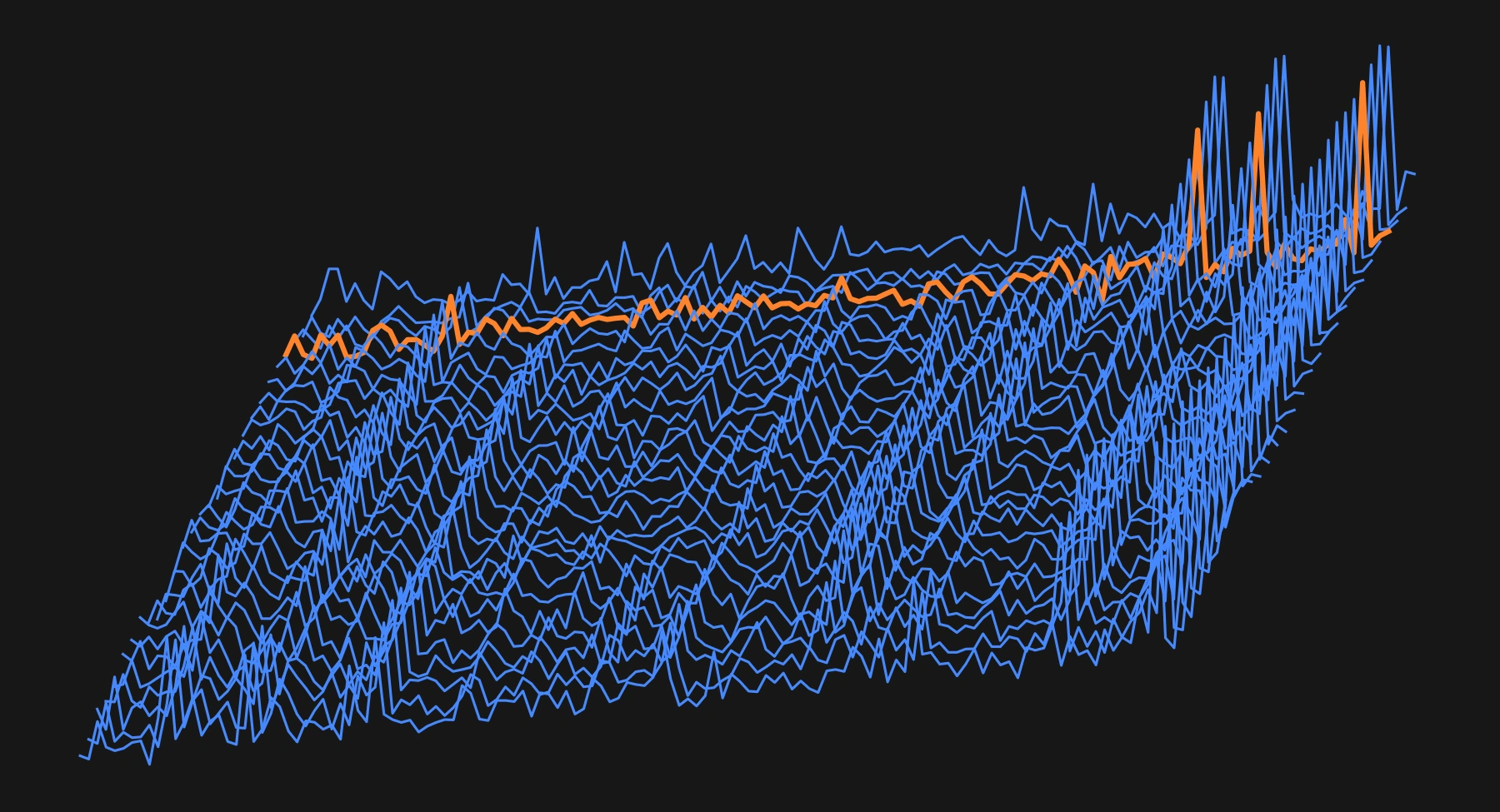
I recorded a separate run on the original prompt. Each line shows one layer as the model was about to predict Paris.
How I measured each layer
I ran Qwen3-1.7B and recorded the last input token after each of its 28 transformer blocks. I split the 2,048 channels into 128 groups of 16 and measured the root mean square of each group. I normalized each row to its own scale and used a log scale for height.
The instrumented run gave exactly the same final scores as an ordinary forward pass. The probability of Paris was 51.7%.
Download the measurementsHow much I changed
In the steering experiment I pushed the layer’s internal state toward Rome and away from Paris. At layer 24, a push one tenth the usual size of that state changed the prediction. The 336 random trials covered the full set of layers and strengths in the experiment.
That result is for this prompt and this model. The plot above comes from a separate run with no push.
Other tests I ran
I also tested 93 prompts that take two steps to answer. On the smaller model, I could read the intermediate answer most clearly at layers 23–25. In another test, those features detected unsupported claims about as well as a simple word-count baseline.
On Qwen3.5-9B, I loaded only the layers I needed and read the feature dictionary in slices. I read 65,536 features at layer 15 using a peak of 6,893 MiB on a 12 GB graphics card.